
Our design software
Altostratus Design
A physics-rigorous, browser-based design environment for ESP, gas-lift and progressing-cavity installations — built for the engineers and operators who size, optimise and audit artificial-lift designs every day.

ESP · Gas Lift · PCP
correlations
available
cases per design
Overview
Designed where the engineering happens
Most artificial-lift tools fall into two camps: vendor spreadsheets that hide their assumptions, or heavyweight modelling suites that take days to deploy and weeks to learn. Altostratus takes a different view — the engineer designing the lift should be able to see every assumption, change any variable, and reach a defensible answer in minutes.
Every routine — IPR construction, multiphase traverses, pump-curve scaling, motor sizing, gas-lift unloading simulation — is visible, parameterised and traceable from input to output. Designs save to a managed library with version stamps, so any case can be reproduced or audited later.
ESP design
Physics, not heuristics
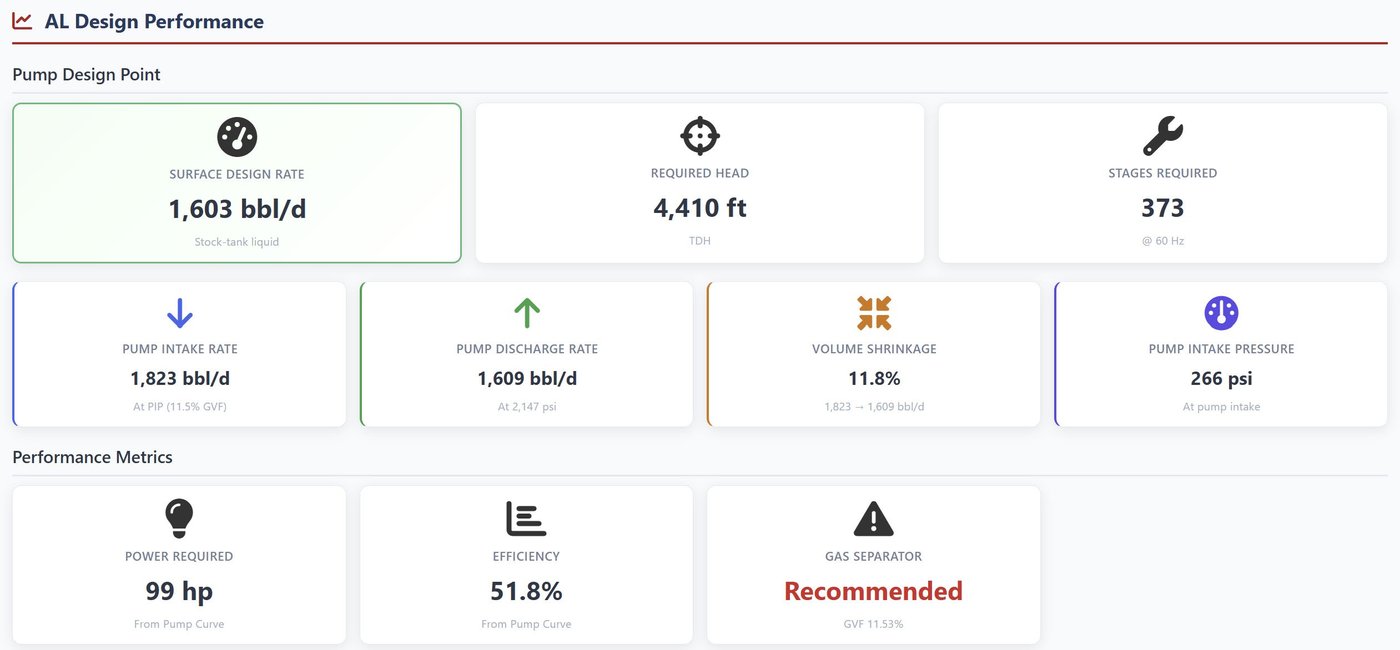
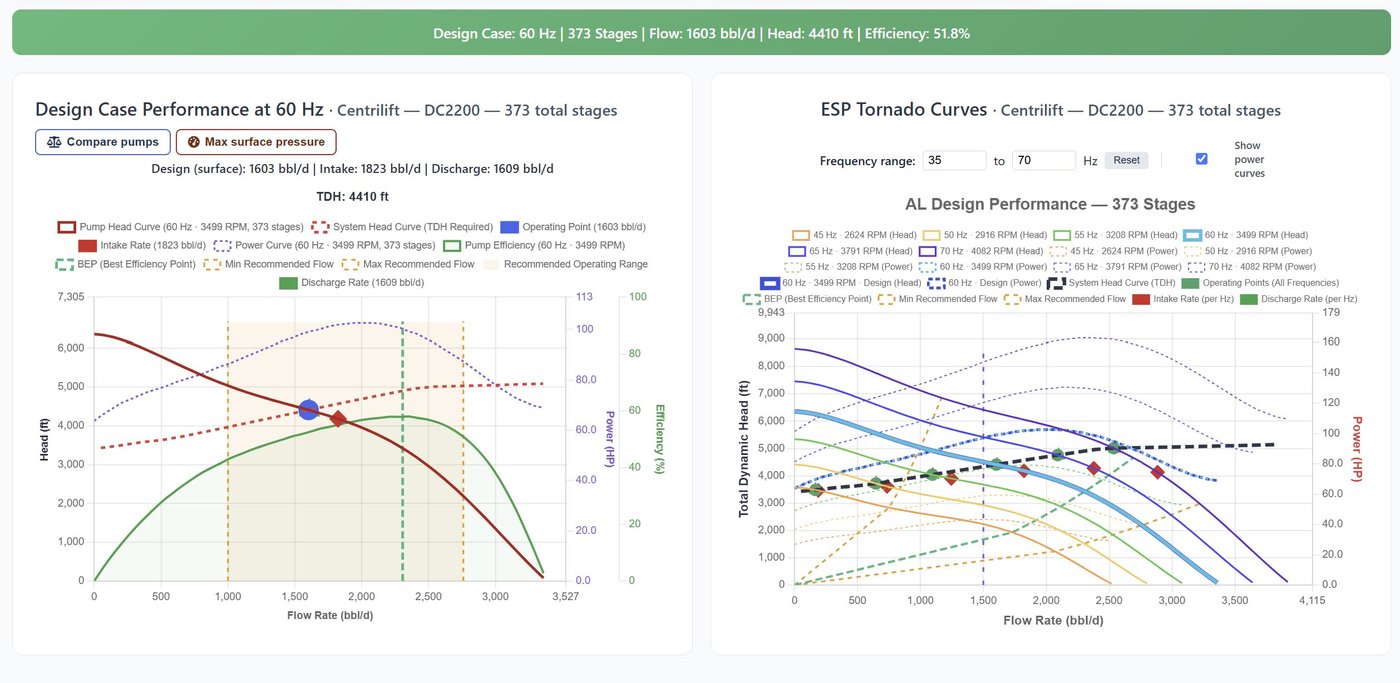
Every step of the ESP chain runs from first principles, with assumptions surfaced and overrideable: a composite Vogel / Fetkovich IPR, a multiphase traverse from the perforations to the wellhead, catalogue pump curves re-scaled by the affinity laws, VSD-aware staging, and a full motor, cable and seal sizing chain.
- Target-rate and target-PIP solvers that iterate frequency to 0.1 Hz, with composite-aware AOF guards
- Gas handling: free-gas volume at intake, separation efficiency and an optional GVF de-rating model
- Shut-in (deadhead) pressure check across the whole frequency × water-cut envelope
- Station-by-station wellbore flow-profile table and a sand-transport screening check
Well analysis & nodal
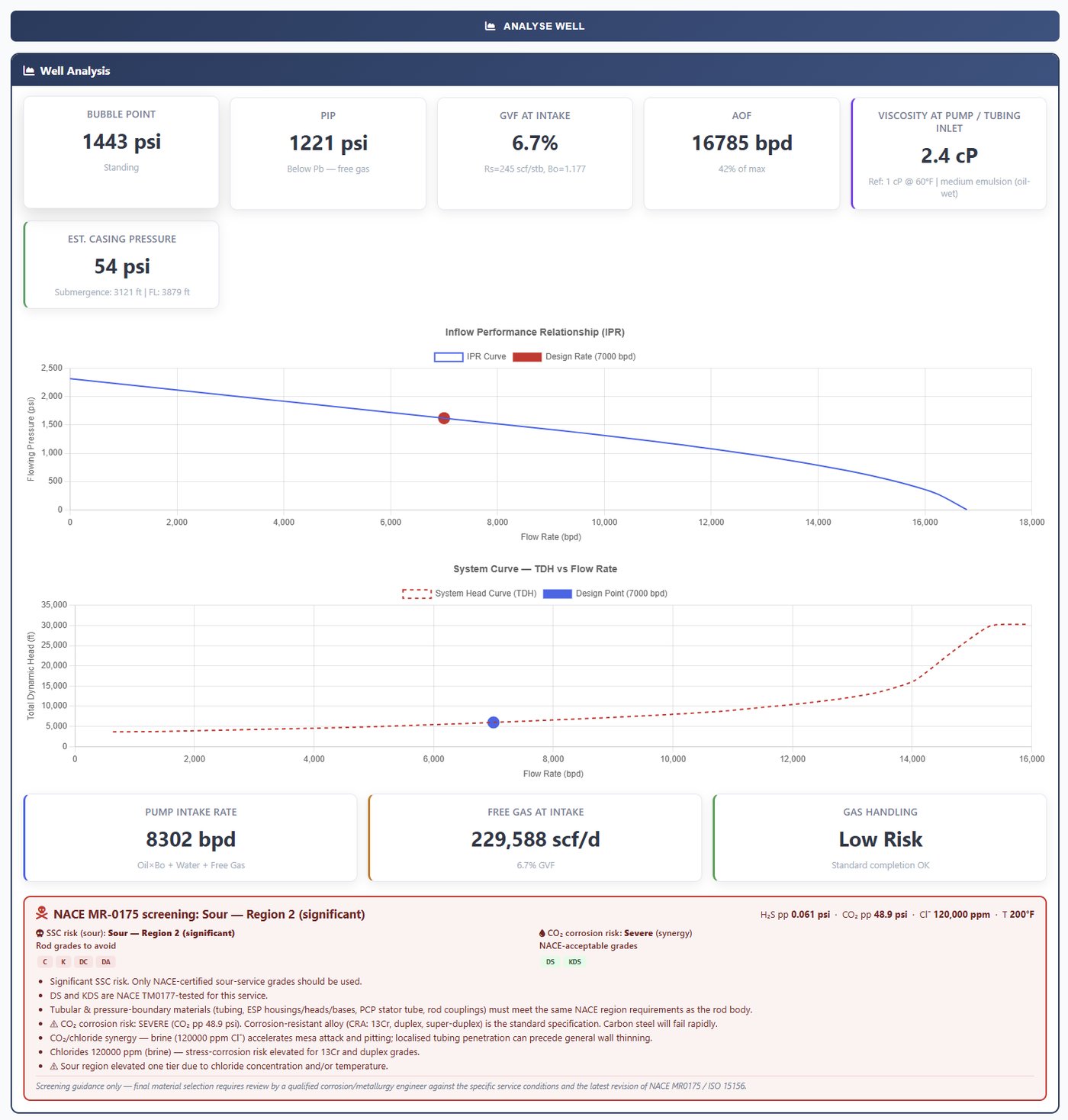
Understand the well before you size the pump
One click computes the IPR, fluid properties at well conditions, the viscosity at the pump (including a Woelflin emulsion model for heavy oil), and a depth–pressure–temperature traverse. A NACE MR-0175 screening flags sour and CO₂ corrosion risk and the acceptable material grades, so metallurgy is considered up front rather than after the design is built.
Gas-lift design
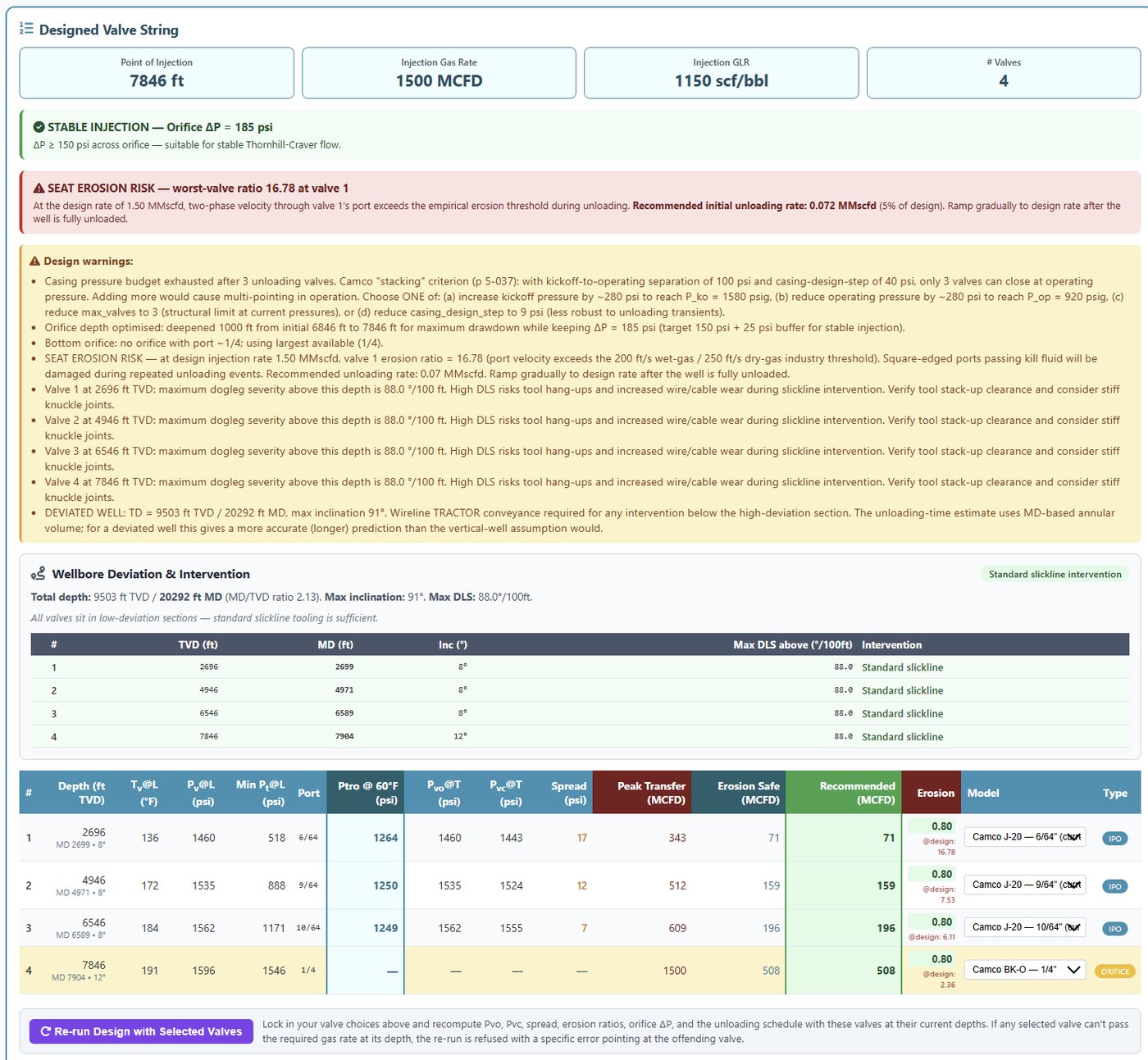
Valve strings that actually unload
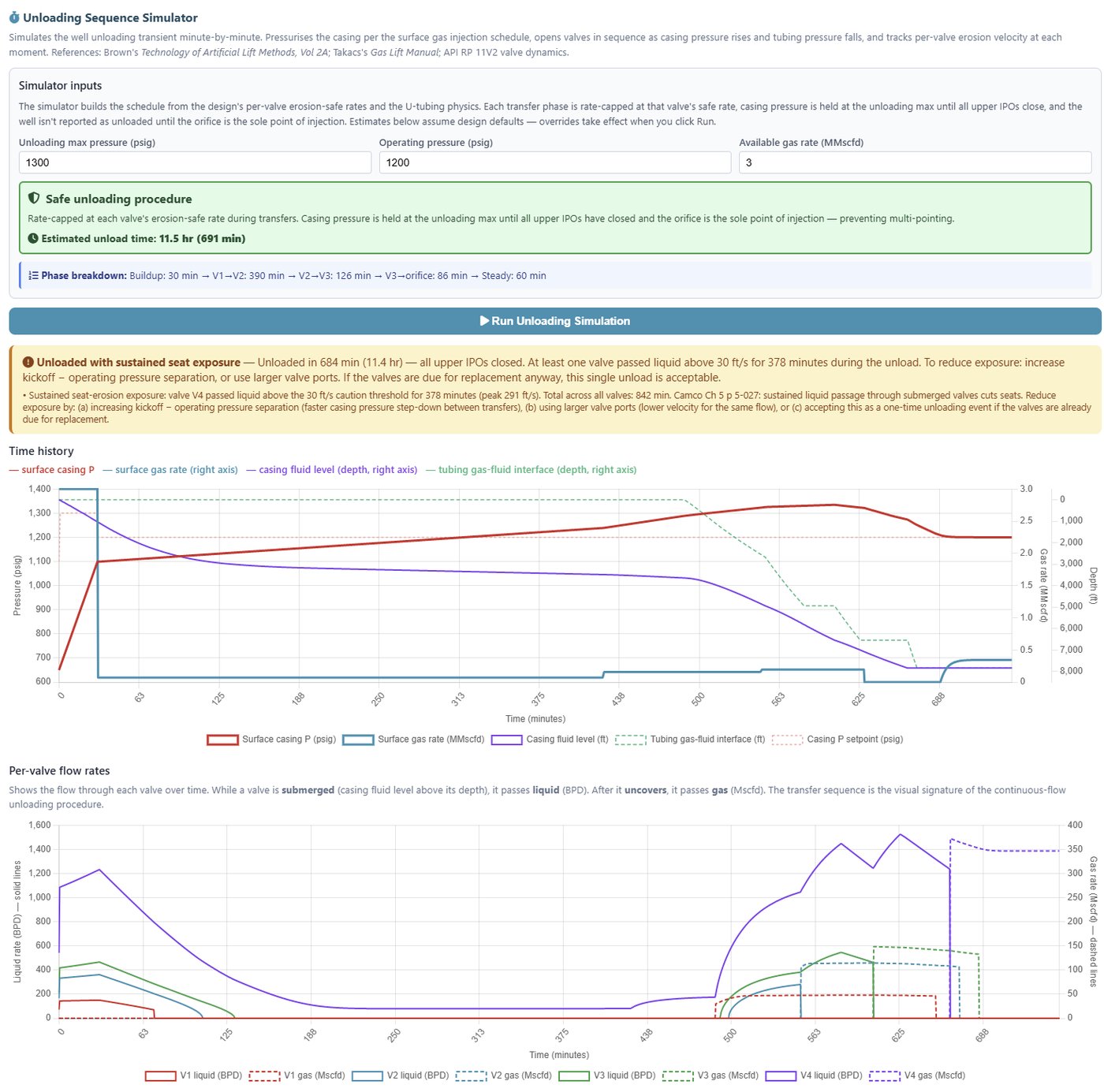
Continuous-flow valve spacing and port sizing with casing-pressure schedules, Thornhill–Craver orifice stability checks, and erosion screening against API 11V2 limits. A time-stepped unloading simulator then runs the unload sequence minute by minute — casing-side gas displacement, valve transfers and kill-fluid U-tubing — to confirm the spacing unloads the well as designed.
PCP & ES-PCP
Progressing-cavity, surface or submersible
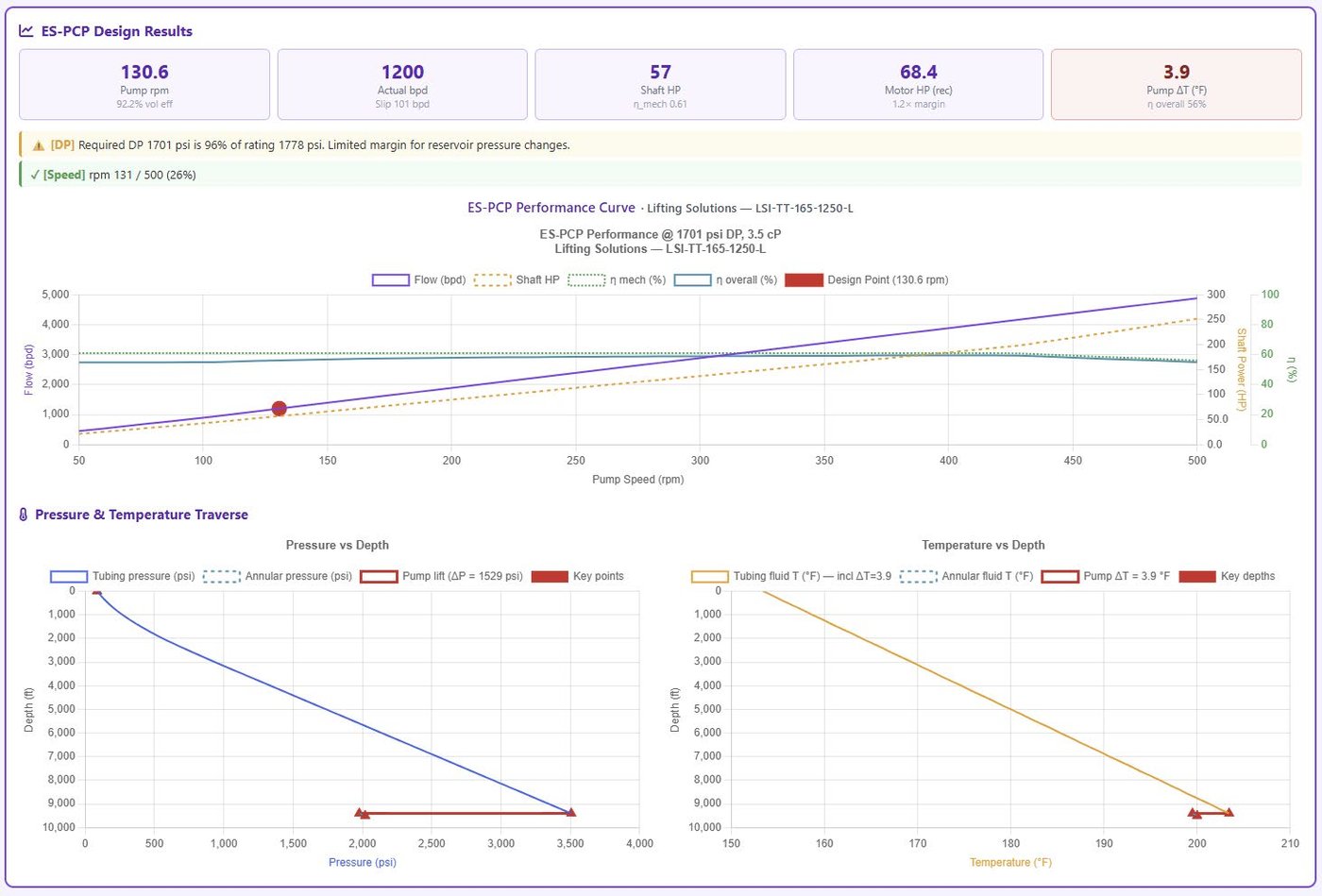
Surface-driven and electric-submersible PCP sizing against catalogue vendor curves: speed selection, slip estimation, volumetric and mechanical efficiency, viscosity effects and shaft / motor sizing — with elastomer selection and heat-rise checks. Rod-driven PCP adds a tapered sucker-rod string with polished-rod loads, von Mises stress and Goodman service-factor utilisation.
Equipment chain
Motor, cable and seal — sized, not guessed
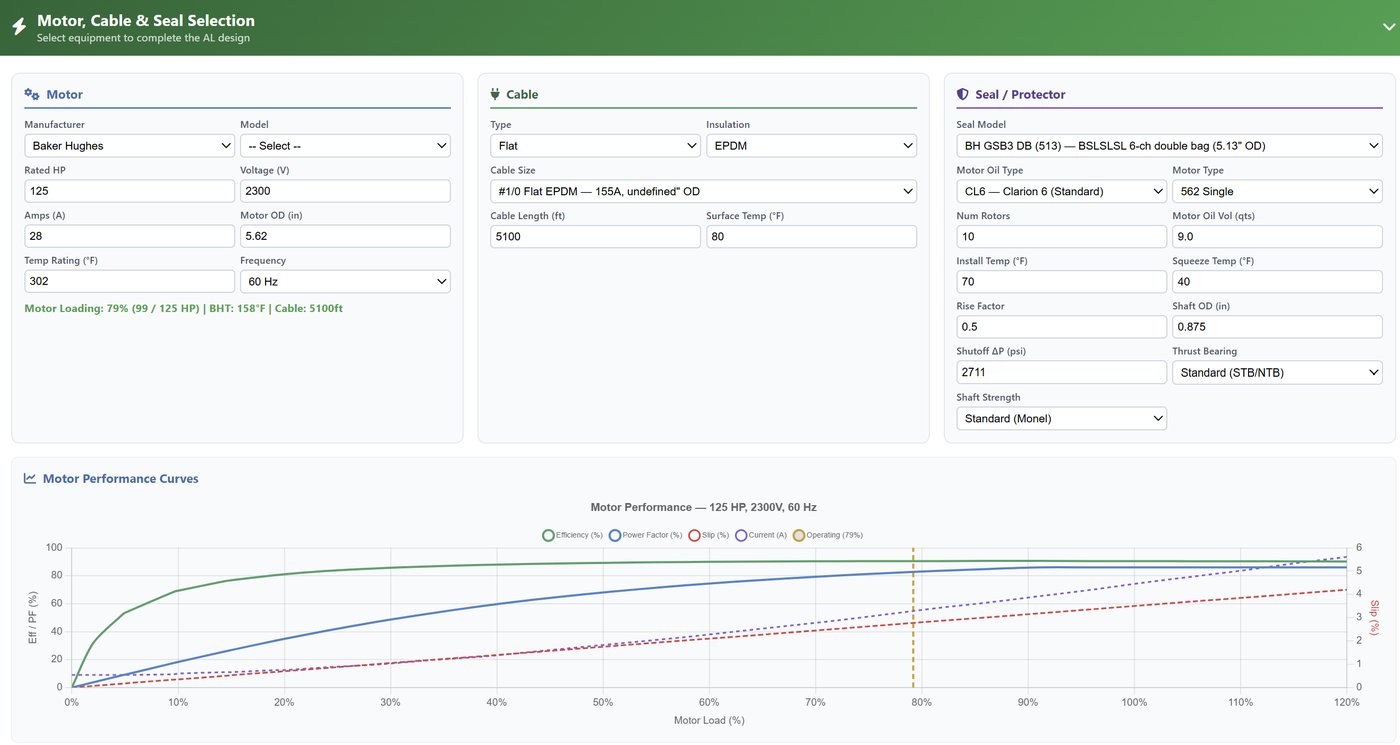
Motor sizing from cumulative shaft horsepower with service-factor margins (induction and permanent-magnet), cable sizing from full-load amps, depth and voltage-drop tolerance with operating amps at the actual solved frequency, and a seal / protector matched to the OD envelope and gas-handling needs.
Workflow
Built to keep up with the work
Multi-case comparison
Save up to ten parameter variations per design and compare them side by side, with rows that flag which inputs changed.
Custom unit systems
Oilfield, metric, or your own combination — conversions are registry-driven so labels, charts and reports all match.
Audit-ready PDF reports
Multi-page reports covering design basis, equipment, pump and system curves, nodal analysis and traverse plots.
Saved-design library
Designs persist across sessions with sharing controls and version stamps recording which engine release produced the numbers.
Six correlations
Hagedorn–Brown, Beggs–Brill, Duns–Ros, Orkiszewski, Aziz–Govier–Fogarasi and a heavy-oil-modified H–B.
Catalogue browser
Preview any pump's single-stage curves before committing, with a per-frequency recommended operating range and BEP locus.
At a glance
Capability by lift type
| Capability | ESP | Gas Lift | PCP / ES-PCP |
|---|---|---|---|
| Composite Vogel / Fetkovich IPR | ✓ | ✓ | ✓ |
| Six multiphase correlations | ✓ | ✓ | ✓ |
| Variable-speed (VSD) design | ✓ | – | ✓ |
| Target-rate / target-PIP solvers | ✓ | – | – |
| Valve / orifice spacing + stability | – | ✓ | – |
| Unloading simulation | – | ✓ | – |
| Motor / cable / seal sizing | ✓ | – | ✓ |
| Multi-case comparison + report | ✓ | ✓ | ✓ |
| Custom unit systems | ✓ | ✓ | ✓ |
Security & trust
Your designs stay yours
The application runs entirely over HTTPS (TLS 1.2+ with HSTS), with a strict content-security policy and clickjacking protection. Accounts use salted one-way password hashing, rate-limited logins, a full login audit trail and optional two-factor authentication, with role-based access and time-limited licensing.
We don't sell your data or designs, we don't show ads in the application, and we don't use your designs to train models without your administrator's explicit consent.
See it against your own wells
Altostratus is offered on annual subscription with named-user pricing. Trial access is available for evaluation against your own well data, and demonstrations can be tailored to a specific field or design scenario.
A full 12-month licence is also included with our ESP Application Engineering course, where the software is provided and used live throughout the training.
Browser-based (Chrome, Edge, Safari, Firefox) · no installation · cloud-hosted with private-tenant and on-prem options.